Fixed or variable? And the mortgage stress test, explained
Fixed or variable is the first big choice you make with a lender, and the stress test decides how much you qualify for either way. Here is how both work, in plain language and real numbers.
Two questions come up in almost every first meeting with buyers: “Should I go fixed or variable?” and “Why does the bank say I qualify for less than I expected?” The second one is the mortgage stress test. Let’s take them one at a time.
Fixed rate: the same payment for the whole term
With a fixed rate, your interest rate and payment are locked for the term, usually 5 years. If rates go up, nothing changes for you until renewal. If they go down, you don’t benefit until renewal either.
Good for: people who want a predictable budget, first-time buyers stretching to buy, and anyone who would lose sleep over rate headlines.
Watch for: the penalty to break a fixed mortgage early can be large (more on that below), and fixed rates are sometimes priced higher than variable.
Variable rate: moves with prime
A variable rate is set as prime plus or minus a margin, for example “prime minus 0.50%”. When the Bank of Canada changes its policy rate, lenders’ prime rates usually follow within a day or two. There are two kinds:
- Adjustable rate: your payment changes every time prime changes.
- Variable rate with fixed payments: your payment stays the same, but the split between interest and principal shifts. If rates climb far enough, the payment may no longer cover the interest (the “trigger rate”), and the lender will ask you to raise it.
Good for: people with room in their budget, those who may sell or refinance before the term ends, and buyers who expect rates to fall.
Watch for: payments or amortization can grow when rates rise. Most lenders let you convert to a fixed rate during the term, usually at their current fixed rate.
What a 1% change does to your payment
On a $500,000 mortgage over 25 years (example rates, same calculation for both):
| Rate | Monthly payment |
|---|---|
| 4.5% | $2,767.36 |
| 5.5% | $3,051.96 |
| Difference | about $285 a month, or $3,400 a year |
A useful test before you choose: could you handle about $285 more a month for every $500,000 you borrow? If yes, a variable rate is a real option. If that would break your budget, fixed is the safer choice.
Breaking a mortgage early: the penalty
Life happens. People move for work, separate, or find a better deal. If you break your mortgage before the term ends, the lender charges a prepayment penalty.
- Variable rate: usually 3 months’ interest. On a $450,000 balance at 4.5%, that’s about $5,060.
- Fixed rate: usually the greater of 3 months’ interest or the interest rate differential (IRD). The IRD is roughly the difference between your rate and the lender’s current rate for the time left in your term, applied to your balance. Simplified example: $450,000 left, 2 years to go, your rate 4.5%, today’s 2-year rate 3.5%. That’s 1% × $450,000 × 2 years, about $9,000. Some lenders calculate the IRD using posted rates, which can push it much higher.
If there’s a real chance you’ll sell within a few years, consider a shorter term, a variable rate, or a mortgage that’s portable (can move with you to a new home). Always ask the lender to explain its penalty calculation in writing before you sign.
The mortgage stress test
The stress test makes sure you could still afford your payments if rates were higher when you renew.
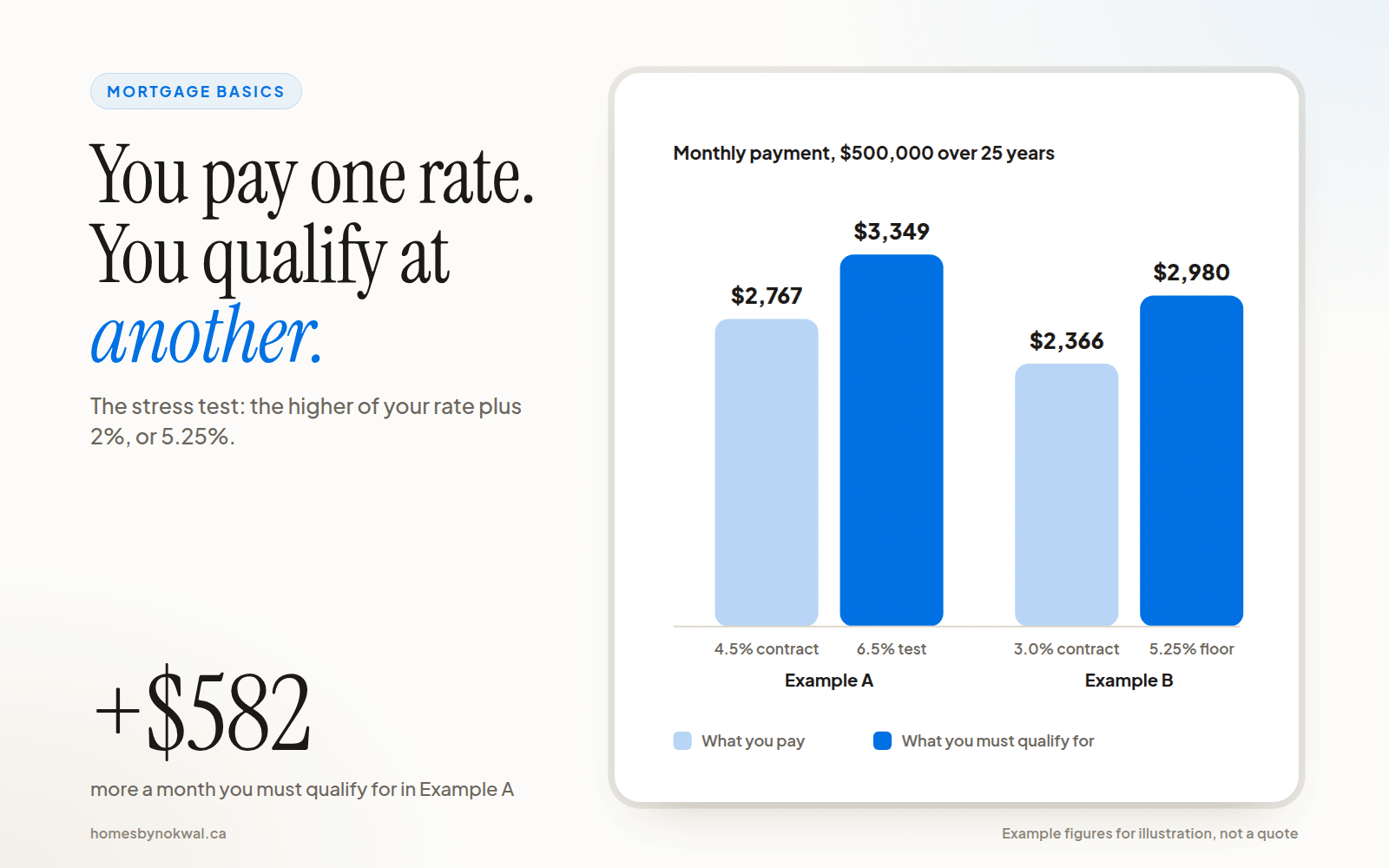
The rule: you must qualify at the greater of your contract rate plus 2%, or 5.25%. It applies to insured mortgages (less than 20% down) and to uninsured mortgages at federally regulated lenders such as the big banks.
You don’t actually pay the higher rate. The lender just uses it when checking your GDS and TDS ratios (see GDS and TDS: the two ratios that decide how much you can borrow).
| $500,000 over 25 years | Example A | Example B |
|---|---|---|
| Contract rate | 4.5% | 3.0% |
| Qualifying rate | 6.5% (4.5% + 2%) | 5.25% (the floor) |
| Payment you actually make | $2,767.36 | $2,366.23 |
| Payment you must qualify for | $3,349.12 | $2,979.59 |
In Example A, you must show you could carry about $582 more a month than you’ll really pay. That’s why the stress test can reduce how much you qualify for by 15% to 20%.
Exceptions worth knowing
- Switching lenders at renewal: since November 2024, if you are not borrowing more or extending your amortization, you generally don’t have to pass the stress test again to move to a new lender. That makes it much easier to shop your renewal.
- Some credit unions in Ontario are provincially regulated and may set their own qualifying rules.
How to choose: a quick checklist
- Budget: could you absorb a 1% rise without stress?
- Timeline: how likely are you to sell or refinance within 5 years?
- Temperament: will you check the news every time the Bank of Canada announces a rate decision?
- Terms: compare prepayment privileges, portability and the penalty formula, not just the rate.
- Advice: a mortgage broker can compare dozens of lenders at once, usually at no cost to you.
There’s no single right answer. The best mortgage is the one you can comfortably carry through a few surprises.
For the basics of term and amortization, read how a mortgage works in Ontario. If you’re buying in Woodstock or anywhere in Oxford County, I’m glad to help you plan.
Figures are examples for illustration only, based on rules in effect in September 2026. They are not a rate quote or financial advice. Penalties vary by lender and are set out in your mortgage contract; your lender or mortgage broker will confirm your numbers.