How a mortgage works in Ontario: term, amortization, rate and payment
Term, amortization, interest rate, payment. Here is what each word means, where every dollar of your payment goes, and a worked example on a $550,000 home.
A mortgage is the biggest loan most of us will ever sign, and the paperwork is full of words that sound alike. Once you know four of them, the rest falls into place: principal, interest rate, term and amortization.
This post walks through each one, then puts real numbers on a typical Oxford County purchase so you can see exactly where your money goes.
The four words you need to know
Principal
The amount you borrow. It is the purchase price minus your down payment, plus the mortgage insurance premium if your down payment is under 20% (the premium is added to the loan, not paid up front).
Interest rate
What the lender charges you to borrow, shown as a yearly percentage. A fixed rate stays the same for your term; a variable rate moves with the lender’s prime rate. One Canadian detail: by law, fixed-rate mortgages here are compounded semi-annually, not monthly. That is why a calculator from a US website can give you a slightly different payment than your Canadian lender.
Term
How long your current contract with the lender lasts, usually 1 to 5 years (5 years is the most common). Your rate is set for the term. When it ends, you renew, and you can renegotiate the rate or move to another lender.
Amortization
How long it would take to pay the mortgage off completely if nothing changed. The standard is 25 years. First-time buyers and buyers of newly built homes can choose 30 years on an insured mortgage, and many lenders offer 30 years when you put 20% or more down.
Term is how long your rate is locked in. Amortization is how long until the house is paid off.
Most people go through five or more terms before the mortgage is gone. Each renewal is a chance to get a better rate, change your payment or pay down a lump sum.
A worked example: a $550,000 home
Here is a typical purchase in Woodstock with 10% down. The rate is an example for illustration, not a quote.
| Item | Amount |
|---|---|
| Purchase price | $550,000 |
| Down payment (10%) | $55,000 |
| Mortgage before insurance | $495,000 |
| CMHC insurance premium (3.10%, added to the mortgage) | $15,345 |
| Total mortgage | $510,345 |
| Example rate | 4.5% fixed, 5-year term |
| Amortization | 25 years |
| Monthly payment | $2,824.62 |
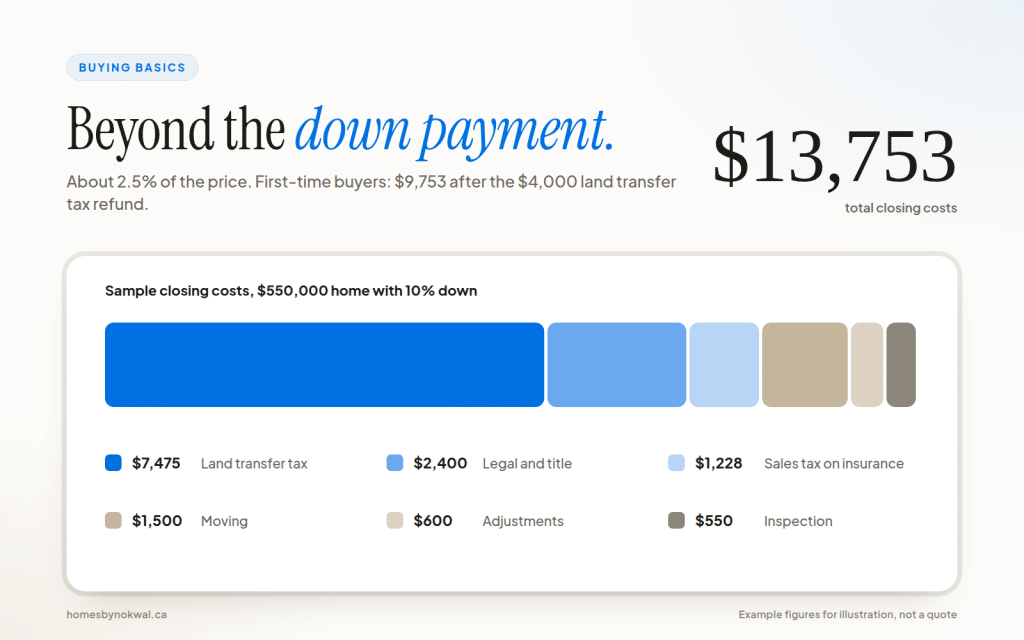
One thing people miss: Ontario charges 8% sales tax on the insurance premium. In this example that is $1,227.60, and it cannot be added to the mortgage. You pay it in cash at closing, along with your other closing costs.
Where your payment actually goes
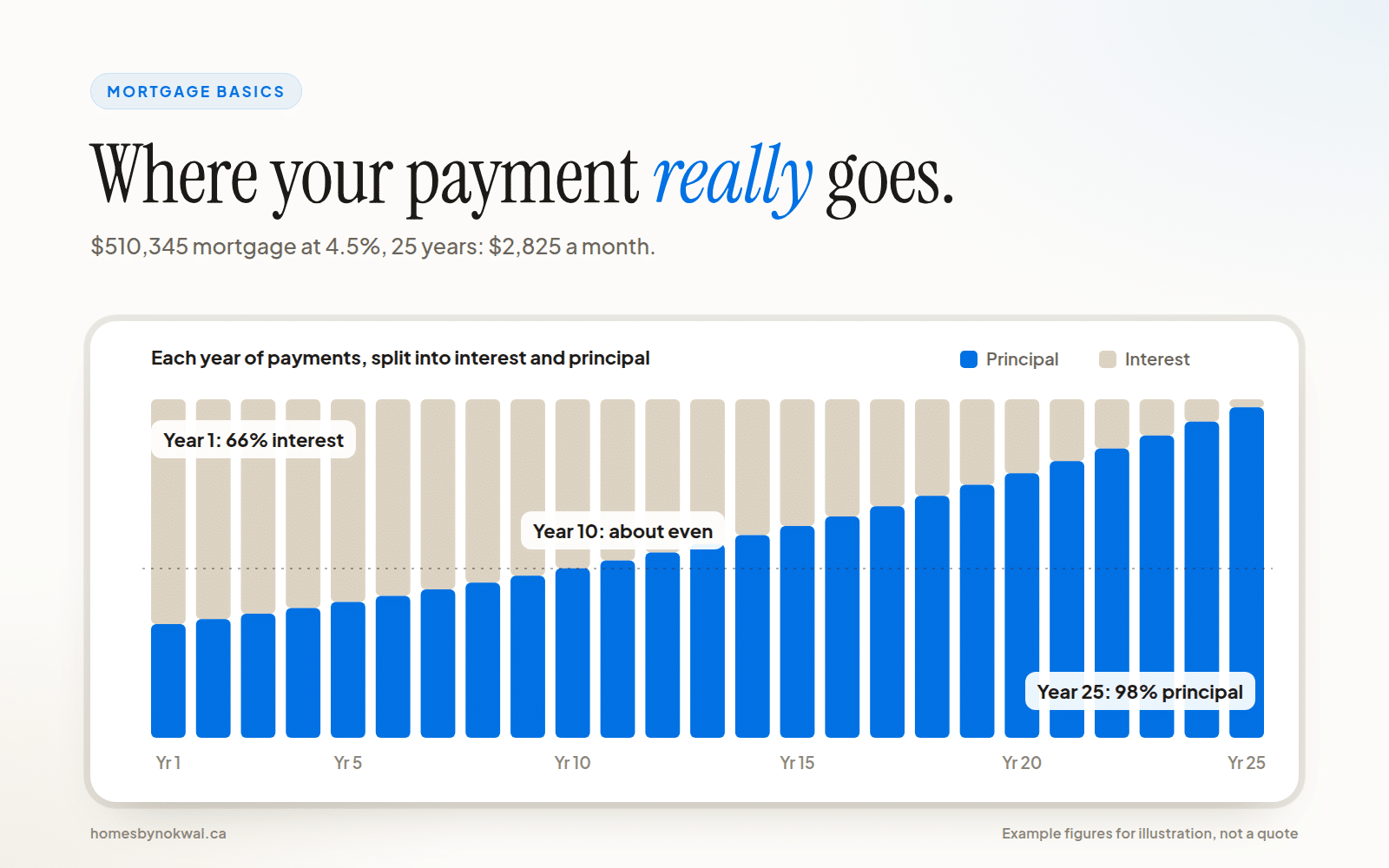
Every payment covers the interest owed for that month first. Whatever is left pays down the principal. Because the balance is largest at the start, the early years are mostly interest.
- Year 1: you pay $33,895 in total. $22,523 of it is interest and $11,373 goes to principal, so about two thirds is interest.
- Year 10: the split is roughly even, $16,920 interest and $16,975 principal.
- Year 25: only $805 is interest and $33,091 is principal.
After the first 5-year term you will have paid $169,477. Of that, $107,197 was interest and $62,281 was principal, leaving $448,064 to renew. If the rate stayed at 4.5% for the full 25 years, the total interest would be about $337,041.
None of this means a mortgage is a bad deal. It means the first few years are when extra payments do the most good.
25 or 30 years?
If you qualify for a 30-year amortization, the monthly payment drops. Using the same example:
| 25 years | 30 years | |
|---|---|---|
| Insurance premium | $15,345 | $16,335 |
| Monthly payment | $2,824.62 | $2,578.23 |
| Total interest (same rate throughout) | $337,041 | $416,828 |
The 30-year option frees up $246 a month, but costs about $79,800 more in interest if you never pay extra. A sensible middle ground: take the lower payment for breathing room, then use your prepayment privileges when you have extra cash.
Three ways to pay less interest
- Use your prepayment privileges. Most lenders let you pay an extra 10% to 20% of the original amount each year, or raise your payment, without a penalty. Check the exact rules in your mortgage contract.
- Pay accelerated bi-weekly. You pay half of the monthly payment every two weeks. That adds up to 13 monthly payments a year instead of 12. In our example, $1,412.31 every two weeks pays the mortgage off in about 21.7 years instead of 25 and saves around $51,000 in interest.
- Shop your renewal. Don’t just sign the renewal letter. Compare offers from other lenders and a mortgage broker. Since November 2024, if you are not borrowing more, you generally don’t need to pass the stress test again to switch lenders at renewal.
Before you start shopping
- Get pre-approved. A pre-approval tells you your budget and usually holds a rate for 90 to 120 days.
- Know your ratios. Lenders decide how much you can borrow with two ratios, GDS and TDS. We explain them in the next post in this series.
- Plan for closing costs. Budget roughly 1.5% to 4% of the price on top of your down payment.
If you are buying your first home, read first-time homebuyer incentives in Ontario and the step-by-step Ontario home buyer’s guide.
Have questions about what you can afford in Woodstock or Oxford County? I’m happy to walk through the numbers with you and connect you with trusted local mortgage professionals.
Figures are examples for illustration only, based on rules in effect in September 2026. They are not a rate quote or financial advice. Your lender or mortgage broker will confirm your actual numbers.