Closing costs in Ontario: what to budget beyond your down payment
Your down payment isn't the only cheque you'll write. Here is every closing cost an Ontario buyer should plan for, including land transfer tax, with a sample budget for a $550,000 home.
You’ve saved the down payment, found the house and firmed up the offer. Then comes closing day, and a list of costs many buyers didn’t see coming. Plan for them now and closing day is just the day you get the keys.
A good starting point: budget 1.5% to 4% of the purchase price for closing costs, in cash, on top of your down payment. Here’s what goes into that number.
Ontario land transfer tax
This is usually the biggest closing cost. Ontario charges it on every purchase, in brackets:
| Portion of the price | Tax rate |
|---|---|
| Up to $55,000 | 0.5% |
| $55,000 to $250,000 | 1.0% |
| $250,000 to $400,000 | 1.5% |
| $400,000 to $2,000,000 | 2.0% |
| Over $2,000,000 (homes with one or two units) | 2.5% |
| Purchase price | Land transfer tax | First-time buyer pays |
|---|---|---|
| $400,000 | $4,475 | $475 |
| $550,000 | $7,475 | $3,475 |
| $750,000 | $11,475 | $7,475 |
First-time buyers get a refund of up to $4,000, which covers the whole tax on homes up to about $368,000. To qualify you generally must be at least 18, a Canadian citizen or permanent resident, never have owned a home anywhere in the world, and move in within 9 months. Your lawyer usually claims the refund for you when the deed is registered, so it comes off your closing bill.
Good news if you’re buying locally: Toronto adds its own municipal land transfer tax, but Woodstock and the rest of Oxford County don’t.
Legal fees and title insurance
You need a real estate lawyer to close. Expect roughly $1,800 to $2,800 including disbursements (title search, registration fees, and so on). Title insurance usually adds $250 to $500 and is often included in the lawyer’s quote. Ask for an all-in quote up front so there are no surprises.
Home inspection
Usually $450 to $650 for a typical house. It’s the best money you’ll spend. On rural properties around Oxford County, budget extra for a well water test and a septic inspection.
Sales tax on mortgage insurance
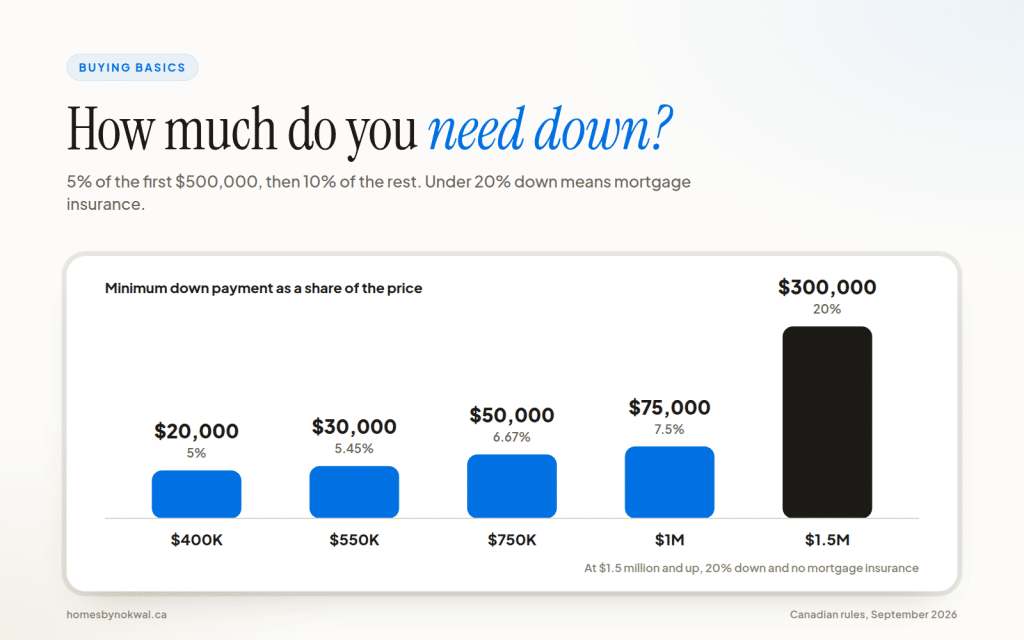
If you put less than 20% down, Ontario’s 8% sales tax on the insurance premium is due in cash at closing. With 10% down on a $550,000 home, that’s about $1,228. See down payment and mortgage insurance in Canada for how the premium works.
Adjustments
If the seller has prepaid property taxes or utilities past the closing date, you reimburse them for your share. The amount depends on the time of year; your lawyer’s statement of adjustments will show it.
Everything else to plan for
- Appraisal: $300 to $500 if your lender doesn’t cover it.
- Home insurance: your lender needs proof of coverage before closing.
- Rental water heater or furnace: many Ontario homes have one. You usually take over the contract, so ask what it costs per month.
- Condos: a status certificate review (your lawyer reads the building’s finances) and prorated condo fees.
- New builds: the agreement can include extra closing adjustments such as utility connections and warranty enrolment fees. Have your lawyer review it before you sign.
- Moving: $1,000 to $3,000 depending on distance and how much you do yourself.
- Day one costs: changing the locks, window coverings, small repairs.
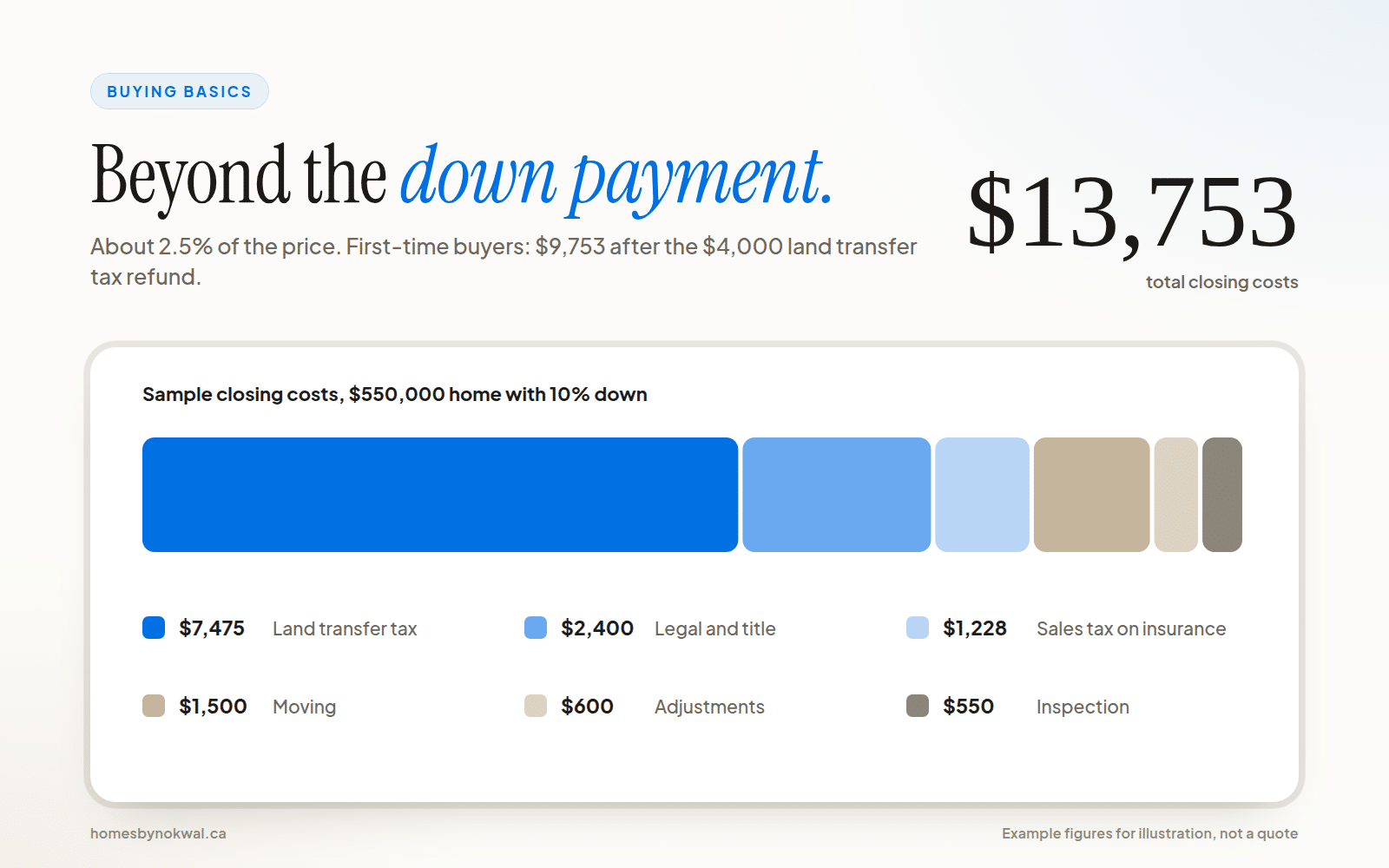
Sample budget: a $550,000 home with 10% down
| Item | Example |
|---|---|
| Land transfer tax | $7,475 |
| Legal fees, disbursements and title insurance | $2,400 |
| Sales tax on the mortgage insurance premium | $1,228 |
| Moving | $1,500 |
| Tax and utility adjustments | $600 |
| Home inspection | $550 |
| Total | $13,753 (about 2.5% of the price) |
| First-time buyer, after the $4,000 refund | $9,753 (about 1.8%) |
These are typical amounts for planning, not quotes. Get actual quotes from your lawyer and inspector.
Tips for a smooth closing
- Show the funds early. Lenders want proof that you have closing costs on top of your down payment, often about 1.5% of the price.
- Keep the money liquid. Your lawyer will ask for the balance a few days before closing, by wire or bank draft. Don’t lock it into an investment you can’t access quickly.
- Leave a cushion. Something always comes up in the first month.
- Ask your lawyer for the statement of adjustments as soon as it’s ready, so you know the exact amount.
For the rest of the buying process, from pre-approval to getting the keys, read the Ontario home buyer’s guide. And if you’re buying in Woodstock or anywhere in Oxford County, I’ll help you plan every number before you make an offer.
Figures are examples for illustration only, based on rules in effect in September 2026. They are not quotes or legal or tax advice. Confirm current land transfer tax rules with your lawyer and the Government of Ontario.