GDS and TDS: the two ratios that decide how much you can borrow
Lenders don't start with the price of the house. They start with two ratios, GDS and TDS. Here is how they work, with a worked example for a household earning $120,000 a year.
When you apply for a mortgage, the lender isn’t asking “how much house do you want?” They’re asking “how much of your income is already spoken for?” The answer comes from two simple ratios: GDS and TDS. Understand these two and you’ll know your budget before you ever see a house.
GDS: your housing costs
Gross Debt Service (GDS) is the share of your gross (before tax) monthly income that goes to the costs of the home itself:
- the mortgage payment (principal and interest)
- property taxes
- heating
- half of the condo fees, if it’s a condo
For an insured mortgage (less than 20% down), GDS can be at most 39% of your gross income. Lenders use similar limits for most other mortgages.
TDS: everything you owe
Total Debt Service (TDS) takes everything in GDS and adds your other monthly debt payments:
- car loans and leases
- credit cards (lenders usually count a set share of the balance, often 3%, even if you pay it off every month)
- lines of credit
- student loans
- support payments
TDS can be at most 44% of gross income. Whichever ratio runs out of room first sets your limit.
One detail matters a lot: the mortgage payment in both ratios is calculated at the stress test rate, not the rate you’ll actually pay.
The qualifying rate is the higher of your contract rate plus 2%, or 5.25%. We cover the stress test in detail in fixed or variable, and the mortgage stress test explained.
Worked example: a household earning $120,000
Two people earning a combined $120,000 a year, with one car loan. The rate is an example, not a quote.
| Item | Monthly |
|---|---|
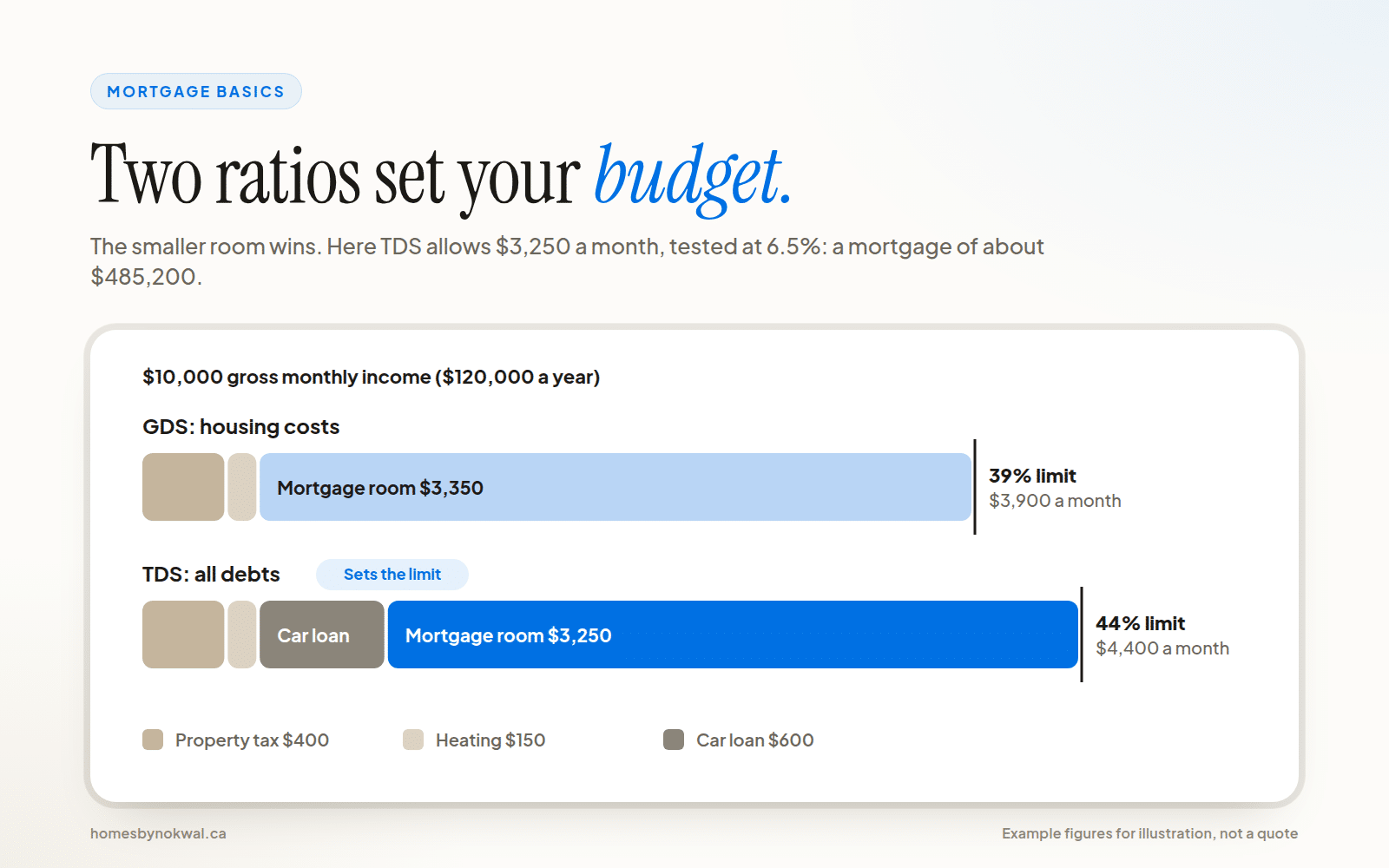
| Gross income ($120,000 a year) | $10,000 |
| GDS limit (39%) | $3,900 |
| TDS limit (44%) | $4,400 |
| Property tax ($4,800 a year) | $400 |
| Heating | $150 |
| Car loan | $600 |
Now subtract the costs from each limit to find the room left for a mortgage payment:
- GDS room: $3,900 minus $400 tax minus $150 heat = $3,350
- TDS room: $4,400 minus $400 minus $150 minus the $600 car loan = $3,250
TDS gives less room, so it wins. The lender tests a payment of up to $3,250 a month at the qualifying rate. With a 4.5% contract rate, that’s 6.5% over 25 years, which supports a mortgage of about $485,200.
What the household would actually pay at 4.5% on that mortgage is about $2,685 a month, noticeably less than the $3,250 tested. That gap is the safety margin the stress test builds in.
With a 10% down payment and the CMHC premium added to the loan, a $485,200 mortgage works out to a purchase price of roughly $520,000.
What changes the answer
- Pay off the car loan first: TDS room rises to $3,850, so GDS becomes the limit at $3,350. The maximum mortgage grows to about $500,100, roughly $14,900 more buying power.
- Without the stress test (for comparison only, since it applies to everyone): the same $3,250 at 4.5% would support about $587,200. The stress test trims about $102,000 off the maximum here.
What counts as income
- Salary and guaranteed hourly pay: your gross amount, confirmed by a job letter and recent pay stubs.
- Overtime, bonus and commission: usually averaged over two years.
- Self-employed: usually two years of Notices of Assessment from the CRA. Some lenders have programs based on stated income.
- Rental income: part of it is usually counted, either added to income or offset against the property’s costs.
Every lender has its own rules for the details, which is one reason a good mortgage broker is worth talking to.
Ways to improve your numbers
- Pay down small debts before you apply. A $600 car payment cost this household almost $15,000 of buying power.
- Don’t take on new credit before closing. No new car, no furniture on a payment plan, no new cards. Lenders often re-check your credit just before closing.
- Add a co-borrower. A spouse, partner or family member on the mortgage adds their income (and their debts).
- Put more down. A bigger down payment means a smaller mortgage for the same house.
- Consider a 30-year amortization if you qualify. It lowers the tested payment, which raises your maximum.
- Compare running costs. Property tax, heating and condo fees all count. Two homes at the same price can qualify very differently.
Your credit score matters too
Ratios decide how much; your credit history decides whether and at what rate. Insured mortgages need a minimum score (600 for at least one borrower with CMHC), and a stronger score opens up better rates. Pull your free credit report from Equifax and TransUnion a few months before you apply so there’s time to fix any errors.
Next steps
Get pre-approved before you start viewing homes. It turns these ratios into a real number and holds a rate while you shop. New to all of this? Start with how a mortgage works in Ontario and the Ontario home buyer’s guide.
If you’d like help figuring out what fits your budget in Woodstock and Oxford County, let’s talk.
Figures are examples for illustration only, based on rules in effect in September 2026. They are not a rate quote, a pre-approval or financial advice. Every lender applies its own policies; your lender or mortgage broker will confirm your numbers.